

Growing stronger: How co-research boosts food resilience to new levels
Januar 21, 2022 2026-08-05 16:30Growing stronger: How co-research boosts food resilience to new levels
Authors: Dr. Silke Stöber, Nomonde Buthelezi, Nicole Paganini, Tandu Ramda
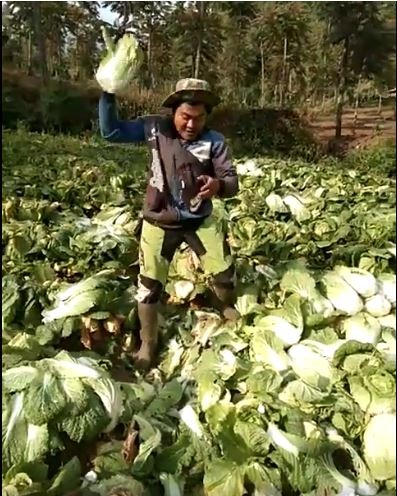
May/June 2020: An Indonesian farmers group destroys cabbage rotting in the field. Due to Covid19-containment measures and related travel restrictions, local markets broke down, and farmers were not able to sell their produce. As a result, vegetables were rotting in the fields in Indonesia and South Africa, while consumers suffered from price spikes. Picture source: Petani kubis indonesia
In April 2020, at the onset of the COVID-19 pandemic, fault lines in the global food system became apparent. IPES-Food identified three destabilising factors that disrupted the global food system as the world enforced COVID-19 containment measures: industrial agriculture and monocultures, which are causing the loss of healthy agro-ecosystems; power imbalances in global food supply chains; and the 800 million people worldwide who still suffer from hunger and malnutrition.
SLE’s co-research partners from South Africa and Indonesia joined forces to conduct a real-time co-research study with small-scale farmers on food growing and consumption during the pandemic.
Nomonde Buthelezi, a political farmer, co-researcher, and head of FACT (Food Agency Cape Town), approached SLE to document how communities in Cape Town’s township tried to cope with the devastating situation during the first lockdown in April 2020. “We do not want to be mere figures in this crisis, not passive victims, but to show what we, as farmers, can do to provide solutions to increasing food insecurity,” said Nomonde Buthelezi. Tandu Ramba, Programme Manager of MPM (Motivator Pembangan Masyarakat, Motivator Community Development Foundation) in Toraja, Indonesia, didn’t need to be asked twice and immediately jumped at the opportunity to join the FACT-SLE group. Fortunately, he and his team also had the right survey tool at hand: the Kobo Toolbox, an easy-to-use survey app that allows different types of questions alongside location data and photo uploads. For six months, we collaborated with farmer groups in two Indonesian regions, Zimbabwe, Mozambique, and South Africa, collecting first-hand insights and photo stories and establishing a South–South exchange platform to learn about each other’s coping strategies.
Almost two years later, we invited both co-researchers, Nomonde and Tandu, to reflect on the impact of this co-research alongside SLE’s sixtieth postgraduate cohort. On 20 January 2022, the SLE team reflected on the changes to Germany’s food system brought about by the pandemic and its control measures, and shared their views in a digital conference with the South African and Indonesian partners.
The co-research approach was a novel method for most of the postgraduate scholars. Only a few, mainly social scientists and ethnologists, had prior exposure to this approach before coming to SLE. The postgraduates expressed a palpable desire to engage in more participatory and inclusive research. This cohort will seek to anchor co-research in their SLE research projects from June this year. The lessons learned from Nomonde and Tandu provided valuable insights into the whys and hows of co-research, including the experiences of both participating communities and scholars learning together, as well as the challenges of doing it well while addressing power relations within the team.
Tandu Ramba reported on the impact and challenges of this co-research in rural Toraja. It is a mountainous rural area with scenic landscapes and rich in traditional ceremonies. Culturally significant funeral ceremonies, helping each other on farms, and community meetings came to a complete standstill during the large-scale social restrictions. More than 300 smallholder farmers who participated in the Kobo Toolbox study reported how they coped with these restrictions. Eating more fruits and vegetables, expanding their gardening, planting multipurpose trees including trees for food, and opening new farmer markets to barter and exchange food were among the major coping strategies for resilience. This is still the case today and, according to Tandu, healthier diets with less meat and less sugar are now more popular amongst Toraja’s 600,000 inhabitants. Tandu reports a strong positive impact resulting from the co-research; for example, local government established programmes including investing in farmers‘ markets in villages. After sharing and discussing the survey results, local government responded with a support programme to promote vegetable gardening. Luckily, as Tandu and MPM promote agroecological intensification, the new gardens are also managed without the use of chemical pesticides and synthetic fertilizers.
Nomonde Buthelezi has drawn a slightly different picture of the urban food system in the Cape Flats, a peri-urban, high-density area of Cape Town. While food resilience receives little government attention in this area, the co-research study has had a major impact on community members’ self-esteem, social cohesion, and community action. For example, the FACT team hosts a podcast to raise local voices and share community members‘ experiences within their own community. Township dwellers are now increasingly engaging in home gardening. Nomonde’s own daughter, who used to dislike vegetables, now likes to go to the vegetable garden to eat fresh carrots pulled out of the ground. Community kitchens are mushrooming, and people perceive these places to be spaces of care where they can gather to receive good nutrient-rich cooked food, kind words, and support. This is a stark contrast to the support offered by other institutions: food parcels built from supermarket scraps like expired cooking oil and white maize flour.
Of course, the digital co-research brought its own challenges. The first thing that came to Tandu’s mind was the lack of signal in the mountainous regions of Toraja. Smallholder farmers were so keen to participate that they ran to places far from their fields and homes to find a signal to contact Tandu via WhatsApp or upload their data to the Kobo Toolbox. At first, the clear and simple English survey questions sounded incomprehensible in Indonesian. Even some of the questions themselves were uncommon or culturally inappropriate. Tandu and his team remained patient and available to answer all questions to achieve good results. Nomonde had similar experiences. Her main problem during this co-research survey was that people never considered tough survey questions such as, “Where does the food you just ate come from?” Embarrassment was also a major, unexpected issue: Respondents said it was difficult to admit their hunger, since they had been taught since early childhood not to talk about hunger and not to beg for alms as a matter of dignity. The shame of hunger is widespread, and many plates remained empty as a result.
Both co-researchers, Tandu and Nomonde, affirmed the power of co-research. In Toraja, the study has had a great impact on local government and good food resilience programmes have emerged. Nomonde would like to see more co-research led by South African universities. From her point of view, the following points are of particular importance.
Leave the space safe and open for the community to be engaged in the research process.
Share data with the community and reward co-researchers as co-authors for their contributions.
Share access to the results not only through scientific journals but also through appropriate and tactile products for the community. This could include, for example, simple presentations of the results in language that is not overly scientific.
Keep relationships alive after the research project has ended. This recommendation is rooted in observations that many research projects mine data from participants, export it to spreadsheets and journal articles, and then abandon the respondents, leaving them feeling used and unvalued. In co-research, it is important to build long-lasting relationships rather than jumping from project to project depending on the donor.
We are all convinced that co-research is the order of the day. Thankfully, it’s no longer acceptable to talk about people without including them in the conversation. In a think-and-action tank on co-research, the SLE would like to deepen this approach with partners such as TMG’s Urban Food Future Programme, FACT, and MPM.
“Eating more fruits and vegetables, expanding their gardening, planting multipurpose trees including trees for food, and opening new farmer markets to barter and exchange food were among the major coping strategies for resilience“
Nomonde Buthelezi describes the challenges they face because of industrial, non-localized food systems
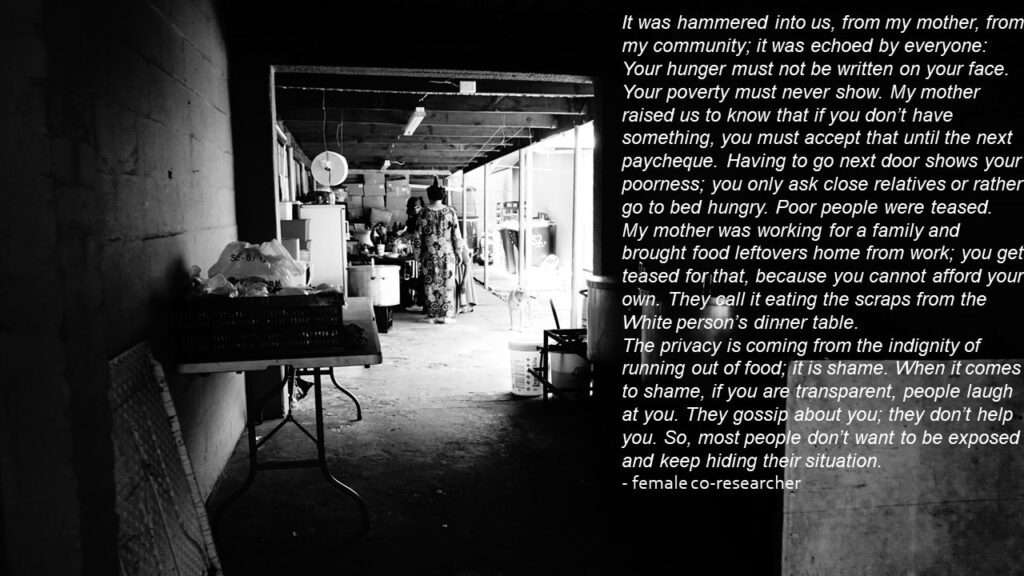
Co-research is an empowering approach to create food agency. Food insecurity and hunger can be shameful for the people suffering from lack of food. Building food agency is an important step to create more self-esteem and empower people to improve their food security situation.
© Silke Stöber, Nomonde Buthelezi, Nicole Paganini, Tandu Ramda

